Showing posts with label Memoir. Show all posts

Tuesday, November 12, 2024

Even Happiness is not Easy


Some years back, a charter member of the my writers group, Gregory Kaspar, wrote of his mother, Josephine Bsales Kaspar, and we published one of her works in our 2020 Encore Writers Group Anthology, There be Writers Here, which can be found as ISBN 9798699228393 and is available for purchase on Amazon.

I may have shared that my mother also did some writing. Since I’ve not lately been able to find my voice to write, I thought I should at least share some of her work with this august body.


My mother, Laura Florence Rasmussen, born into this life in a log cabin during the cold, bleak days of February 1909, grew up on a small family farm along the banks of the Snake River near Burley, Idaho. She graduated from high school in 1927, one of the first in her bloodline to have done so. I remember her telling me in my youth a little of her memories of high school days and especially fondly recalling her senior year drama class production of Shakespeare’s A Midsummer Night’s Dream, a production in which she had a speaking part. Considering what I have learned over the years about this fantastical work of stagecraft, I wonder how it was presented and how well it was received in 1927 by the parents of the students in this mostly Mormon community. Well, things were thoroughly modern by then, if you believe the lyrics as sung by Julie Andrews in 1967, and had, according to Richard Rogers in an earlier work, “…gone about as fer as they can go.” I do know that she knew how to dance both the Charleston and the Lindy and would occasionally demonstrate those dances for me, usually in our kitchen while wearing an apron. At Grange Hall dances I never saw my father dance anything but the waltz, the two-step, or the round-a-bouts of square dancing. Other than those occasions, I never saw him dance at all!


During the early 1950s, my mother was regularly published in a weekly article in the Sunday edition of the Twin Falls, Idaho Times News. I very clearly recall seeing clippings of some of her pieces when I was a pre-teen and her telling me what they meant. She wrote in a humorous and satirical vein about the weather, local government, buyers (sometimes sharp) dealings with farmers, and associated gossip in a column called ‘Pot Shots,’ as if she were a citizen writing to the editor, signing her missives with the pseudonym Sy Clone. I especially remember one article from a clipping harpooning a local city council's decision to eliminate the public bus system in Twin Falls. A decision that was finally reversed in 2023 to meet Federal requirements. Sadly, I have been unable to reproduce any of those clippings in that small-town newspaper’s archives. I can find digital online photos of the paper’s pages with the ‘Pot Shots’ column heading clearly visible, but nothing else is readable in those copies.


She also wrote poetry. She said the word, ‘poetry’ only applied in the loosest terms to her work. So far as I know, none of the poems were ever published. Amongst my keepsakes is an e-document of 60 pages with her musings. This was originally in a journal in her handwriting but has been transcribed by my niece. As the daughter of my eldest sibling, she has custody of the original. Many of my mother's short poems are whimsical. Probably none rise to the level of ‘literature.’ Nevertheless, I will share a few samples here. I am copying them as they are transcribed to my e-document, spelling and punctuation unchanged.


For reasons I will explain after this first example, I start with a poem she titled Inspiration. It is the 28th entry in the collection. Were I a poet, I may have written this with my mother as subject.


Inspiration


Among my mother’s virtues,

The thing I love the best,

How vividly, I recall

Her radiant happiness.


Always, as she did her work,

She hummed a lively song;

And to me her singing seemed

To speed the work along.


Now, that she is laid to rest,

And from her I sadly part,

Still her joyous singing

Will live on in my heart.


And often now, I sadly wish,

When everything goes wrong,

I could rouse from life’s nightmares

And waken to her song.


But then I stop to ponder,

That I, too, must be strong

And fortify mine own heart

With glad, inspiring song!


Laura Florence R. Moyes


Now, my reason for choosing this piece as my first to represent her work: First and foremost, some of my earliest childhood memories are of the sound of Mother singing happily as she worked in her brightly sunlit kitchen. Her movements over the cheap linoleum flooring were dance-like as she baked or cooked or just simply cleaned. Her kneading of bread dough on the yellow and white Formica countertop was always in rhythm with her singing. For such strenuous work, she would select a lively and rhythmic song such as Harry Belafonte’s version of “Day-O (The Banana Boat Song).” Lighter work might be accompanied by a work such as Billie Holliday’s “On the Sunny Side of the Street,” or Debbie Reynolds’ “Singin’ in the Rain.” She knew all the words by heart.


I mentioned that her singing seemed happy. Her voice rang clear and as bright as the sunlight streaming through the kitchen windows. The second thing influencing my selection is, my mother had a rough life with much hardship and some tragedy, as did her mother. In neither case should the happiness in their voices be taken for granted. Reading the above poem, with my mother talking about her mother’s happy singing and referencing life’s nightmares is, to me, reflective and insightful of the human condition. That bright, streaming sunshine has the power to reveal dust particles afloat in the air and old stains and smudges on the bright beige, yellow, green, and blue linoleum. Sadness and disappointment must have been hidden behind hope and faith in their voices.


Now, to lighten the mood a bit, I will share some of her more whimsical work.


Call on Carter


When you all get married,

And I know you all will

And your hubby gets grouchy

Tho he's not really ill-

Hop in your car - step on the starter

And hurry to visit Mr. Earl Carter.


Why visit this gent, you might ask

He'll give you something in a flask

The contents will fill your man with cheer

No, it isn't just a glass of beer.

This something will make your man happy

So happy you will think he's sappy.


He'll feel so good - I just know

He'll want to take you to a show;

Next morning he'll rise early - maybe

And even offer to tend the baby;

And when his blues all disappear

He'll even call you honey-dear.


What is Carter's miracle in the flask

Ladies, you will want to ask,

This stuff that takes away all ills

It's - Carter's little liver pills!


Florence Moyes


As it is getting late this Tuesday evening, and I have miles to go before I sleep—but I exaggerate as I plagiarize Robert Frost—I am only about 30 feet from my bedroom. I will end with only one more entry from her work. I could tell you much more of her life and some of the life of her mother, but I will leave that for another time.  Here’s the last entry for tonight:


Ga-Ga

I'm almost going ga-ga

Listening to the radio's blaa-blaa

So instead,

I'll go to bed.


L. F. M.


Saturday, December 9, 2023

Pronouncing Giclée is not EZ

Today I learned that giclée (pronounced zhēē-clay) is an English word coined to describe high-quality ink-jet printer art. It was derived in the early 1990s and was based on the French word gicleur, a word from the automotive or mechanical trades meaning jet or spray. I've also learned that to type the accented e used as the fifth letter in giclée using a Windows computer, you must hold down the 'alt' key while entering the ASCII code for é, 0233, using the keyboard's number pad. That letter has what is known as the 'acute accent' and it is pronounced more or less like a long a, ā, in English. Only the number pad works for this. The numbered keys across the top of the keyboard won't work and in fact, seem to do nothing whatever when the 'alt' key is held down. This is in keeping with the universal law, as implemented by Microsoft, that nothing is ever as easy as it should be.

The casual reader may note I have wasted a good deal of my day learning these few trivial facts and wonder: Why? I will explain. 

But first I must say I do not find this a waste of my time. I learned something new! What I haven't learned, yet, is this: Why does giclée use an acute accented e while the French word it was derived from, gicleur, does not? Such perverse facts do not increase my understanding of the English-speaking world's interface with the French way of life. 

I began my in-depth research of this arcane topic after reading an article this morning written by native Idahoan, Rick Just, in his daily Idaho history blog, Speaking of Idaho. Rick told of noted 19th-century artist Thomas Moran. Rick tells us that Mr. Moran was one of the few artists of his time well-known for depicting the scenery of the Rocky Mountains in still-life works. His media of choice was often watercolor. One of Mr. Moran's works mentioned by Mr. Just got my attention. The work, painted by Thomas Moran in watercolor in 1900, is titled Shoshone Falls on the Snake River, Idaho. The original is now in a museum in Tulsa, Oklahoma, the legislature of Idaho having failed to appropriate $10,000 to purchase the work when offered by Mr. Moran's estate after his death, in 1926. That original is valued at many hundreds of thousands of dollars.

My parents lived less than one mile from Shoshone Falls in 1950 when I was born in Twin Falls, Idaho. As I grew up, we often picnicked and played in the park near the top of the falls in the Snake River Canyon. Rick's article included a link to the work. Clicking that link, I found a picture of a work of art of which I happen to have a framed giclée print displayed on the wall in my home. 

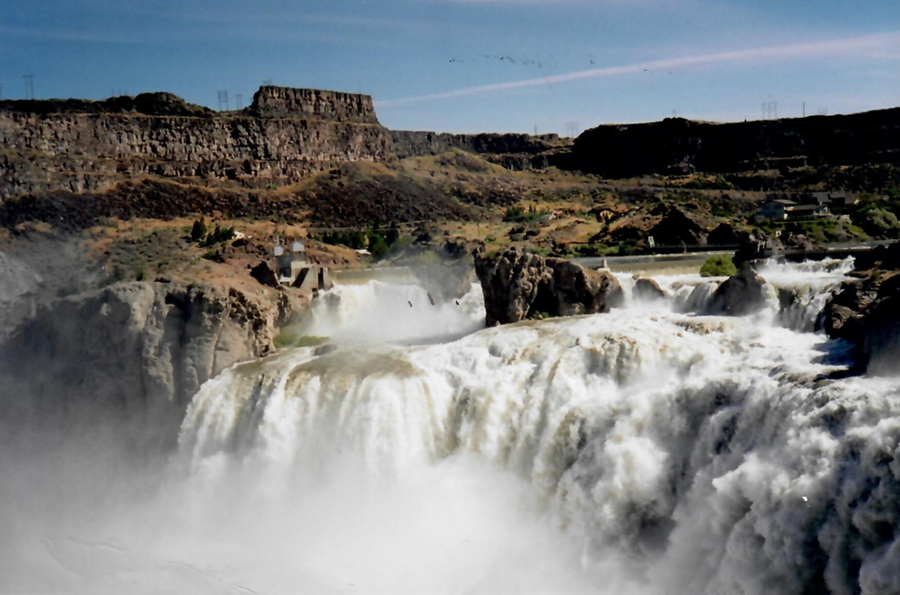
Here's what I am proud of: My framed print of Mr. Moran's work is displayed alongside a print of a photograph of Shoshone Falls that I captured on a Sony digital camera in 1997. The perspective of the image in the photo is nearly identical to that in Mr. Moran's work. In the century since Mr. Moran painted Shoshone Falls, the water flow has been greatly diminished as the Snake River has been dammed upstream and water has been diverted for municipal, industrial, and agricultural uses. Mr. Moran's painting shows the falls in tumult with a very heavy flow. In 1997, I was blessed to be able to capture my image of the falls early in the spring after an unusually wet winter with heavy snowfall in the mountains. So even the cascade of the water looks similar in my photograph. 

Presented here, for your viewing enjoyment, is an image of the famous (and valuable) 1900 work of art by Mr. Thomas Moran (1837-1926) along with an image of the photograph captured in 1997 by the unknown and unappreciated author of this piece. 

Shoshone Falls on the Snake River, Idaho. Watercolor, 1900, Thomas Moran

Shoshone Falls on the Snake River, Idaho. Photograph, 1997, Dan Moyes


This original photograph is now valued at a quarter of one dollar.

Oh, and after more painstaking research, I have now learned the reason the acute accented e is used in giclée and not in the French original: The accented e was added to avoid confusion with the French street slang word giclee which is used to refer to male ejaculate. Now I am sorry I learned this. Such perverse facts do not increase my understanding of my world's interface with that of the artist. Thank you, Microsoft Copilot, for your AI search of this topic to enlighten me. 

And thank you, reader, for your time. 


Thursday, March 5, 2020

Memoir writing is not EZ - 001 of 127

At our last writers' group meeting, one of our number handed out a device as an aid in writing memoirs. (Memoirs have been our focus for the past couple months.) The handout consists of a list of 127 questions and is titled, "127 Writing Prompts to Finish Before You Write About Yourself." In looking at the 127 questions two things stand out to me: (1) By writing answers to these questions you ARE writing about yourself, and (2) It's a long, long road from number one to number 127. I've decided to challenge myself to complete the entire list and I'm going to publish them here. I'll first quote the question and follow that up with my written response. So here goes: Number 001 of 127 naval-gazing posts:

1. What is your best physical feature? Why do you like it? Describe it.

To determine which physical feature is my best I would like a bit more detailed definition of best. Best for what purpose? Everyday living? Accomplishing unusual tasks? Attracting a love interest? Further, this question may have been easier to write about many years ago before all of the physical features in question began to deteriorate due to advancing age.

Were I to stand in front of a full-length mirror in my pink and untanned birthday suit I wouldn’t see much that I would like. My body shows the ravages of life: scars from youthful adventures; excess fat from an easy and plentiful life; a couple of reminders of medical procedures. My feet are OK—not badly calloused or distorted from tight shoes. My legs are strong and always have been. I walk a lot and these legs have to carry a heavy load contributing to their strength. On the subject of legs, I’ve been blessed with very little trouble with knees or ankles. Going back to the mirror, though, those legs just look too chunky – too short and heavy to call my best feature. Upper body strength is something I’ve never had. My biceps are not well-defined, my chest is flabby, so let’s not write any more about that portion of my anatomy. Face? No—I’ve often been told I have a great face for radio. My teeth are straight and have been relatively trouble-free, but who wants to write about their teeth? My eyes are blue, and I like that, but my vision is too weak to call the eyes my best feature. Wearing glasses improves my appearance because they hide part of my face! Because I’m writing this for an undefined audience that will likely include mixed company let’s not even consider any more personal bodily real estate.
Having ruled out most everything, where does all of this leave us? What’s left?
Well, let me tell you…

That’s it! I can tell you. The voice! My favorite physical feature is my voice. A speaking voice, not a singing voice. I have always wished I could sing, and everyone who has ever heard me try to sing wishes much the same. But speaking! Oh, I do like my voice and I have received kudos for the sound of that voice and my use of it. It’s not an incredibly deep, bassy voice nor is it overly shrill and high-pitched. When I pay attention I can modulate the sound with good effect, though the range falls far short of the three octaves that were showcased so well by Roy Orbison in his work. In my career, I have, by request, served as the voice for public service announcements, promotional videos, entire instructional courses, and the introduction of Top-40 music hits on the radio (does anyone remember radio?) I’ve also been asked to sit down and shut up at Karaoke events. There is a great difference between speaking and singing!

So, there you have it. My favorite physical feature cannot even be seen in front of that full-length mirror. That’s probably a blessing to all.