We just finished a 12-day, 2500 mile driving vacation in the Intermountain West of the USA. We departed Mesa, AZ, drove through Arizona, Nevada, Idaho, Utah, and back to Arizona. We visited family and saw many beautiful sites, experiencing a few adventures along the way. We returned safe and well, but, oh, so tired. My beloved spouse (of 7 months) and I are both in our '70s. I'm further in than is she. We found the travels fun but punishing, unlike it would have been 30 years ago.
Thursday, August 13, 2026


Monday, January 6, 2025
Keeping Social Standards is Not EZ.
This is from July 16, 2018. I thought I had written this up in my blog (here) but had actually published it elsewhere. It took some dedicated searching to find it as I clearly remembered writing the event up but could not remember where I posted it. Having found it, here it is;
Naked people give nudists a bad name!
At about 9 this evening we heard loud screaming coming from out front. With my Monday night bowl of cantaloupe pieces in hand I went out front to investigate. Just outside the front door Mrs. Brown ran up to me from her house and babbled something about a naked young man on her front porch.
Why was he on her front porch?
Because he’d been pounding on her back door and she wouldn’t let him in.
A few more neighbors gathered as the naked young man walked toward us in the glow of the street light. One could not help but notice that he appeared to be a particularly fine specimen of a young adult male. Near 6 feet tall and maybe 170 pounds he was trim, muscular, nearly hairless, and very well “built.” He was loud and abusive as he approached and was waving his arms and shaking...various parts...I told him to back away but he didn’t. He approached me talking loud nonsense but I did not retreat. I sat my bowl of cantaloupe on the brick mailbox enclosure but palmed the fork in case I needed a sharp surprise.
After I was assured 9-1-1 had been called I engaged him in small talk to keep him busy until the police 👮 could arrive. He told me his name was Elliott and he was 19. I asked about medication and he said no. I asked about self medication and he said well yes, obviously. For 45 minutes I held his attention and engaged him briefly between his demonstrations of physical prowess that could have passed for modern interpretive dance or simulated sex with asphalt. Or both. Now that I think of it, wouldn’t simulated sex with asphalt make a grand name for a punk band?
Finally an officer arrived and cuffed Elliott. It took a second officer on scene to convince him to cooperate and get into a cruiser. At that point he told the officers that he had been receiving treatment at a hospital about a mile away and had simply walked out leaving his hospital robe behind.
As the cars pulled away my eldest son FINALLY showed up with the popcorn. I hope Elliott gets good and effective treatment—he needs it.
Points scored: after the fact I told the wife, “See, there was nothing sexy about that nudity.” She agreed.
Friday, November 15, 2024
Musical Musings are not EZ
Moyes' Monday Musical Musings
I started this
post on Monday, November 11, 2024. I am just now, evening November 15, getting
around to posting it.
Del Shannon’s debut single, ‘Runaway,’ written by Shannon and keyboardist Max Crook, released on my mother’s 52nd birthday, February 18, 1961, was a major international hit topping the Billboard charts for four consecutive weeks ending the year as the number five song for 1961. It was also one of my favorite songs through my early teen years. The song has been covered by The Lawrence Welk Orchestra, Elvis Presley, Bonnie Raitt, the Traveling Wilburys, and many others. Del Shannon re-recorded ‘Runaway’ in 1967, 1986, and 1987 (recorded live on the David Letterman Show with Paul Shaffer and the World’s Most Dangerous Band. It was used in American Graffiti in 1973 and in Good Will Hunting and Eddie and the Cruisers. Shannon’s 1987 remake was used as the opening theme for the Crime Story television series, and in Dexter: New Blood on Showtime. Tom Petty mentions the song in Runnin’ Down a Dream, as does the group Barenaked Ladies in When You Dream. Genesis sampled a bar in their song In the Cage.

Runaway. Photo by Kate Darmody on Unsplash
While listening to ‘Runaway’ tonight, I was struck by the similarity in the message with that in the lyrics of another very popular song from the 1960s that I continue to enjoy very much: ‘Sukiyaki’ (U.S. title) or ‘Ue o Muite Arukō,’ by Kyu Sakamoto. While the musical styles are very different, there is a similarity in the feeling they present the listeners, along with the message of the lyrics, although I find ‘Sukiyaki’ to be more authentically melancholy.
Compare the lyrics, below, or even better, listen to them on YouTube at https://youtu.be/ttpzuzkD6NQ?si=Fb5VwUViiUkTBWFW and
https://youtu.be/C35DrtPlUbc?si=xi1x5s2yWPC0eTgZ .
‘Ue o Muite Arukō’ is sung in Japanese on this YouTube version, but the English lyrics are displayed to read.
Like ‘Runaway,’ ‘Sukiyaki’ was released in its home country in 1961. For ‘Ue o Muite Arukō,’ that country was Japan. It didn’t hit the U.S. market re-titled ‘Sukiyaki’ until 1963. It quickly became an international chart-topper, spending three weeks in the number one spot on the American Billboard Charts in June of 1963, and eventually one of the best-selling singles of all time, selling over 13 million copies. NASA used an instrumental version as mood music for the astronauts aboard the Gemini VII spacecraft, making the song the first known piece of human music played in space. It has been the subject of a Google Doodle. Credit for ‘Sukiyaki’ goes to composer Hachidai Nakamura and lyricist Rokusuke Ei. The song has been remade or covered by numerous artists, with the January 1981 single release by U.S. group A Taste of Honey reaching number one on Billboard’s Adult Contemporary chart and number three on the Billboard Hot 100.
Lyrics,
Runaway (https://genius.com/Del-shannon-runaway-lyrics)
[Verse]
As I walk along I wonder
A-what went wrong with our love
A love that was so strong
And as I still walk on
I think of the things we've done together
A-while our hearts were young
[Chorus]
I'm a-walkin' in the rain
Tears are fallin' and I feel the pain
A-wishin' you were here by me
To end this misery and I wonder
I wah-wah-wah-wah-wonder, why
Why, why, why, why, why she ran away
And I wonder a-where she will stay-ay
My little runaway, a-run, run, run, run, runaway
Lyrics, Sukiyaki (https://www.azlyrics.com/lyrics/kyusakamoto/sukiyakiuewomuitearukou.html) Note: This translation of the lyrics is slightly
different than those displayed on YouTube.
I look up while I walk
So the tears won't fall
Remembering those spring days
But tonight I'm all alone
I look up while I walk
Counting the stars with teary eyes
Remembering those summer days
But tonight I'm all alone
Happiness lies beyond the clouds
Happiness lies above the sky
I look up while I walk
So the tears won't fall
I cry while I walk
For I am alone tonight
Remembering those autumn days
But tonight, I'm all alone
Sadness hides in the shadow of the stars
Sadness hides in the shadow of the moon
I look up while I walk
So the tears won't fall
My heart is filled with sorrow
For tonight I am alone
For tonight I am alone
Shannon’s ‘Runaway’ is also renowned in the music industry
for the first use of the very distinctive sound of the electronic instrument
called the Musitron, an instrument created and played by co-author Crook. The
very unusual piercing and crescendoing sound of the Musitron is very obvious in
the song’s bridge between verse and chorus.

‘Sukiyaki’ is renowned for being the first Japanese song to do well with American audiences since before World War II. In 1963 we were less than 20 years from the end of that horrendous struggle which cost many lives and much wealth. Americans were still sensitive. ‘Sukiyaki’ came to our shores at the same time that Japanese electronics and automobiles were being newly introduced. The cars and the electronics became well accepted within a relatively short time, primarily due to the value they offered. ‘Sukiyaki’ remained the only Japanese hit to have reached the American Billboard list for several decades. I find this fact ironic, as Rokusuke Ei did not write the lyrics as a lost love song, as it seems. Rather, it was to express his sadness over U.S. domination of Japan in the early 1960s. He actually first put the lyrics to voice while walking home (in the rain) from a student demonstration against the American presence in Japan.
References from which I have heavily borrowed for these musings:
Medium. (2019). Medium. http://medium.com,
“Del Shannon’s ‘Runaway’
and the Mystifying Sound of the Musitron, Excerpt from ‘200 Greatest 60s Rock
Songs’’, Edgar Street Books as published in The Riff.
Www.azlyrics.com. https://www.azlyrics.com/lyrics/kyusakamoto/sukiyakiuewomuitearukou.html
Del Shannon
– Runaway.
(2022). Genius. https://genius.com/Del-shannon-runaway-lyrics
Wikipedia. (2014). Wikipedia.com. http://wikipedia.com
Tuesday, November 12, 2024
Even Happiness is not Easy
Some years back, a charter member of the my writers group, Gregory Kaspar, wrote of his mother, Josephine Bsales Kaspar, and we published one of her works in our 2020 Encore Writers Group Anthology, There be Writers Here, which can be found as ISBN 9798699228393 and is available for purchase on Amazon.
I may have shared that my mother also did some
writing. Since I’ve not lately been able to find my voice to write, I thought I
should at least share some of her work with this august body.
My mother, Laura Florence Rasmussen, born into
this life in a log cabin during the cold, bleak days of February 1909, grew up
on a small family farm along the banks of the Snake River near Burley, Idaho.
She graduated from high school in 1927, one of the first in her bloodline to
have done so. I remember her telling me in my youth a little of her memories of
high school days and especially fondly recalling her senior year drama class
production of Shakespeare’s A Midsummer Night’s Dream, a
production in which she had a speaking part. Considering what I have learned
over the years about this fantastical work of stagecraft, I wonder how it was
presented and how well it was received in 1927 by the parents of the students
in this mostly Mormon community. Well, things were thoroughly modern by then,
if you believe the lyrics as sung by Julie Andrews in 1967, and had, according
to Richard Rogers in an earlier work, “…gone about as fer as they can go.” I do know that she knew how
to dance both the Charleston and the Lindy and would occasionally demonstrate
those dances for me, usually in our kitchen while wearing an apron. At Grange
Hall dances I never saw my father dance anything but the waltz, the two-step,
or the round-a-bouts of square dancing. Other than those occasions, I never saw
him dance at all!
During the early 1950s, my mother was regularly
published in a weekly article in the Sunday edition of the Twin Falls, Idaho
Times News. I very clearly recall seeing clippings of some of her pieces when I
was a pre-teen and her telling me what they meant. She wrote in a humorous and
satirical vein about the weather, local government, buyers (sometimes sharp)
dealings with farmers, and associated gossip in a column called ‘Pot Shots,’ as
if she were a citizen writing to the editor, signing her missives with the
pseudonym Sy Clone. I especially remember one article from a clipping
harpooning a local city council's decision to eliminate the public bus system
in Twin Falls. A decision that was finally reversed in 2023 to meet Federal
requirements. Sadly, I have been unable to reproduce any of those clippings in
that small-town newspaper’s archives. I can find digital online photos of the
paper’s pages with the ‘Pot Shots’ column heading clearly visible, but nothing
else is readable in those copies.
She also wrote poetry. She said the word,
‘poetry’ only applied in the loosest terms to her work. So far as I know, none
of the poems were ever published. Amongst my keepsakes is an e-document of 60
pages with her musings. This was originally in a journal in her handwriting but
has been transcribed by my niece. As the daughter of my eldest sibling, she has
custody of the original. Many of my mother's short poems are whimsical. Probably none
rise to the level of ‘literature.’ Nevertheless, I will share a few samples
here. I am copying them as they are transcribed to my e-document, spelling and
punctuation unchanged.
For reasons I will explain after this first
example, I start with a poem she titled Inspiration. It is the 28th
entry in the collection. Were I a poet, I may have written this with my mother as subject.
Inspiration
Among
my mother’s virtues,
The
thing I love the best,
How
vividly, I recall
Her
radiant happiness.
Always,
as she did her work,
She
hummed a lively song;
And
to me her singing seemed
To
speed the work along.
Now,
that she is laid to rest,
And
from her I sadly part,
Still
her joyous singing
Will
live on in my heart.
And
often now, I sadly wish,
When
everything goes wrong,
I
could rouse from life’s nightmares
And
waken to her song.
But
then I stop to ponder,
That
I, too, must be strong
And
fortify mine own heart
With
glad, inspiring song!
Laura
Florence R. Moyes
Now, my reason for choosing this piece as my
first to represent her work: First and foremost, some of my earliest childhood
memories are of the sound of Mother singing happily as she worked in her
brightly sunlit kitchen. Her movements over the cheap linoleum flooring were dance-like as she baked or cooked or just simply cleaned. Her kneading of bread
dough on the yellow and white Formica countertop was always in rhythm with her
singing. For such strenuous work, she would select a lively and rhythmic song
such as Harry Belafonte’s version of “Day-O (The Banana Boat Song).” Lighter
work might be accompanied by a work such as Billie Holliday’s “On the Sunny
Side of the Street,” or Debbie Reynolds’ “Singin’ in the Rain.” She knew all
the words by heart.
I mentioned that her singing seemed happy. Her
voice rang clear and as bright as the sunlight streaming through the kitchen
windows. The second thing influencing my selection is, my mother had a rough
life with much hardship and some tragedy, as did her mother. In neither case
should the happiness in their voices be taken for granted. Reading the above
poem, with my mother talking about her mother’s happy singing and referencing
life’s nightmares is, to me, reflective and insightful of the human condition. That
bright, streaming sunshine has the power to reveal dust particles afloat in the
air and old stains and smudges on the bright beige, yellow, green, and blue
linoleum. Sadness and disappointment must have been hidden behind hope and
faith in their voices.
Now, to lighten the mood a bit, I will share
some of her more whimsical work.
Call
on Carter
When
you all get married,
And
I know you all will
And
your hubby gets grouchy
Tho
he's not really ill-
Hop
in your car - step on the starter
And
hurry to visit Mr. Earl Carter.
Why
visit this gent, you might ask
He'll
give you something in a flask
The
contents will fill your man with cheer
No,
it isn't just a glass of beer.
This
something will make your man happy
So
happy you will think he's sappy.
He'll
feel so good - I just know
He'll
want to take you to a show;
Next
morning he'll rise early - maybe
And
even offer to tend the baby;
And
when his blues all disappear
He'll
even call you honey-dear.
What
is Carter's miracle in the flask
Ladies,
you will want to ask,
This
stuff that takes away all ills
It's
- Carter's little liver pills!
Florence Moyes
As it is
getting late this Tuesday evening, and I have miles to go before I sleep—but I
exaggerate as I plagiarize Robert Frost—I am only about 30 feet from my
bedroom. I will end with only one more entry from her work. I could tell you
much more of her life and some of the life of her mother, but I will leave that
for another time. Here’s the last entry
for tonight:
Ga-Ga
I'm
almost going ga-ga
Listening
to the radio's blaa-blaa
So
instead,
I'll
go to bed.
L. F. M.
Wednesday, October 9, 2024
The Year of Our Discontent
NOT EASY
I’ve not been able to write for some time. A couple years ago, it was my favorite activity. But I’ve been off.
2024 has not been an easy year. In truth, I guess, things haven’t been great for several years. I am at that stage of life that things change quickly and my level of control over those changes seems minimal. It has been said that growing old ain’t for the weak.
Saturday, December 16, 2023
Some Mornings are Not EZ.
I awoke this morning thinking that I did not feel well by any measure.
Physically, I felt fatigued and achy. My digestion wasn't behaving well.
Emotionally, I felt drained, down, and blue.
Intellectually, I felt like I had given up.
Spiritually, I felt empty. I would not have known how to answer if someone asked my why I existed.
But still, nature called. My loyal and loving fluffy white dog, Dak, needed his morning walk. With effort, I slowly dressed and donned my hat and coat. Gathering the clean-up bags, training treats, and his leash along with my strength, I called him. With the leash secured to his harness, at the speed of a snail, we were off.
My canvas slip-ons made a chuff-chuff sound. I saw the cracks in the concrete walkway, rabbit droppings and discarded gum wrappers littered the path as I shuffled along, head down. I did not feel any spring in my step. The chill morning breeze knifed through my light fleece jacket.
'Why,' I wondered, 'do I even bother with this. Dak could do his business in the back yard without me.'
As I drew a deep sigh, something to my right, a flash of light, caught my attention. I stopped and shifted my view up and to the East. And there it was. A stunning sunrise. Not yet above the Superstitions, the sun's golden-yellow presence was making itself felt in a halo over the mountains. The powerful light turned the wispy overhead cirrus clouds to magnificent shades from gray to purple to pink to almost white. The night sky was yielding to a graduated blue – lighter on the horizon and darker directly above. The golden glow of the morning sun was reflected about me. The plain, gray concrete walk even glowed with a reddish tint. This was just what I needed.
In this sunrise, in an instant, God showed me beauty all around that I had temporarily forgotten existed. It lifted me.

Photo by Steve Baune. Mesa, AZ. December 16, 2023. Used with permission.
Physically, I didn't feel much different, but the body aches and grumbly tummy didn't seem so important any more.
Emotionally, as I looked up, I felt up.
Intellectually, it seemed there was much to do, and enjoy this day.
Spiritually, thankful. Perhaps I had a smile or an encouraging word to share with someone who needed it.
For this, and so much more, I am thankful to my God.
Saturday, December 9, 2023
Pronouncing Giclée is not EZ
Today I learned that giclée (pronounced zhēē-clay) is an English word coined to describe high-quality ink-jet printer art. It was derived in the early 1990s and was based on the French word gicleur, a word from the automotive or mechanical trades meaning jet or spray. I've also learned that to type the accented e used as the fifth letter in giclée using a Windows computer, you must hold down the 'alt' key while entering the ASCII code for é, 0233, using the keyboard's number pad. That letter has what is known as the 'acute accent' and it is pronounced more or less like a long a, ā, in English. Only the number pad works for this. The numbered keys across the top of the keyboard won't work and in fact, seem to do nothing whatever when the 'alt' key is held down. This is in keeping with the universal law, as implemented by Microsoft, that nothing is ever as easy as it should be.
The casual reader may note I
have wasted a good deal of my day learning these few trivial facts and wonder:
Why? I will explain.
But first I must say I do not
find this a waste of my time. I learned something new! What I haven't learned,
yet, is this: Why does giclée use an acute accented e while the French word it
was derived from, gicleur, does not? Such perverse facts do not
increase my understanding of the English-speaking world's interface with the
French way of life.
I began my in-depth research of
this arcane topic after reading an article this morning written by native
Idahoan, Rick Just, in his daily Idaho history blog, Speaking of Idaho.
Rick told of noted 19th-century artist Thomas Moran. Rick tells us that Mr.
Moran was one of the few artists of his time well-known for depicting the scenery
of the Rocky Mountains in still-life works. His media of choice was often
watercolor. One of Mr. Moran's works mentioned by Mr. Just got my attention.
The work, painted by Thomas Moran in watercolor in 1900, is titled Shoshone
Falls on the Snake River, Idaho. The original is now in a museum in Tulsa,
Oklahoma, the legislature of Idaho having failed to appropriate $10,000 to
purchase the work when offered by Mr. Moran's estate after his death, in 1926.
That original is valued at many hundreds of thousands of dollars.
My parents lived less than one
mile from Shoshone Falls in 1950 when I was born in Twin Falls, Idaho. As I
grew up, we often picnicked and played in the park near the top of the falls in
the Snake River Canyon. Rick's article included a link to the work. Clicking
that link, I found a picture of a work of art of which I happen to have a
framed giclée print displayed on the wall in my home.
Here's what I am proud of: My
framed print of Mr. Moran's work is displayed alongside a print of a photograph
of Shoshone Falls that I captured on a Sony digital camera in 1997. The
perspective of the image in the photo is nearly identical to that in Mr.
Moran's work. In the century since Mr. Moran painted Shoshone Falls, the water
flow has been greatly diminished as the Snake River has been dammed upstream
and water has been diverted for municipal, industrial, and agricultural uses.
Mr. Moran's painting shows the falls in tumult with a very heavy flow. In 1997,
I was blessed to be able to capture my image of the falls early in the spring
after an unusually wet winter with heavy snowfall in the mountains. So even the
cascade of the water looks similar in my photograph.
Presented here, for your viewing enjoyment, is an image of the famous (and valuable) 1900 work of art by Mr. Thomas Moran (1837-1926) along with an image of the photograph captured in 1997 by the unknown and unappreciated author of this piece.
 |
| Shoshone Falls on the Snake River, Idaho. Watercolor, 1900, Thomas Moran |
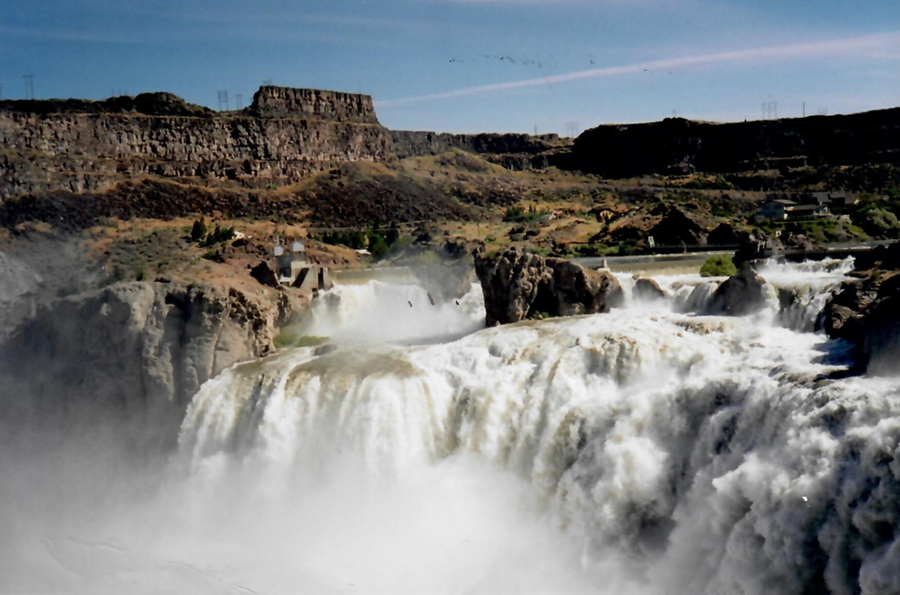 |
| Shoshone Falls on the Snake River, Idaho. Photograph, 1997, Dan Moyes |
This original photograph is now valued at a quarter of one dollar.
Oh, and after more painstaking research, I have now learned the
reason the acute accented e is used in giclée and not in the French original:
The accented e was added to avoid confusion with the French street slang word giclee which is used to refer to male ejaculate. Now I am
sorry I learned this. Such perverse facts do not increase my understanding of my
world's interface with that of the artist. Thank you, Microsoft Copilot, for
your AI search of this topic to enlighten me.
And thank you, reader, for
your time.
Thursday, December 7, 2023
The Mexican Adventure Was Not EZ
Dramatized Non-Fiction
December 1, 2023
1466 Words
Chapter One – Huntsville, Utah Territory, Forty miles NE of Salt Lake City, May, 1892
The piercing cry of the Spruce Hawk rang out in the humid morning air over the mountain slopes on the east side of the Wasatch Ridge in the Uintah Mountains. James Moyes had already been up and at work for several hours, stripping bark from cut white pine logs using a sharp bill hook. Pulling off his leather hat, he wiped the sweat from his brow with his rough, denim sleeve. He could taste the salt from the sweat on his lips. Jim knew that the local natives revered the Spruce Hawks. The Uintah Indians had taught that these hawks were a messenger from the divine, telling their people to be vigilant, look at all the facts, and use inherited wisdom to figure out what the universe was trying to say. In his Mormon culture, he knew the elders would say to listen to the promptings of the holy spirit. So far, the spirit hadn’t chosen to tell Jim much about the current situation.
Right now, Jim was just trying to figure out what was going on in the mind of his elder brother, William.
Jim didn’t know if anything had ever been more confusing or harder to understand than what William had told him just that morning. Jim had lived nearly thirty years. He had traveled from Glasgow to Utah as a mere child. Now married to Elizabeth for more than five years, they had shared the devastating loss to illness of their first two children. He’s seen much that was hard and confusing, but Jim could make some sort of sense of all that. But this? This new idea of Bill’s just didn’t seem to make any sense at all! Bill and Jim shared middle names, Gowans, from their mother’s family name, but it was becoming apparent to Jim that name may be all they shared. That and sore backs and blistered hands from working timber six days a week.
Across the small, newly cleared space of the forest floor, Bill put down his axe. Pulling off his own, sweaty hat, he crossed the fresh clearing, skirting downed and stripped pine logs. Later, he and Jim would bring the oxen up from their place near Huntsville and drag the huge logs, one at a time, down the mountain to Bill’s water-powered sawmill, on the banks of Wolf Creek.
After a long drink from their shared canvas water bag, Bill called to Jim, “These are good logs, Jim, but it’s a long way to drag ‘em down to the mill from here. If we were stayin’ in Utah we’d have to move even further up toward Ben Lomond to find decent-sized stands. I’m glad we’re leavin’ for Mexico!”
There it was. Bill’s hairbrained idea.
“Aw, Bill, listen for once. That’s plum crazy! We can’t just up and move to Mexico, lock, stock, and barrel. Cogitate on this, man! You’ve got a wife and four young ‘uns. You got a 10-year lease with harvest rights on this stand of mountain timber and a fine working sawmill here. Our old man and Uncle Robert run the biggest lumber yard in northern Utah, sellin’ your planks for hard cash as fast as we can rip ‘em from the pine logs and your eight oxen can haul ‘em down the canyon to Ogden. Talk about crazy! Who’s Pa gonna buy his lumber from if not us? I know you’re my elder brother and my boss and all, and I mean no disrespect, but man, if I’ve ever seen crazy, this is it! What do you know about Mexico, anyway? What’s there that’s better than what you got here?”
“And, Bill, you know us leavin’ will break Ma’s heart!”
“Jim, Jim, Jim. Don’t be tryin’ to talk me out of it. And don’t be gettin’ all emotional. I am pretty well set on this. You remember Brother Charles Holm? He was with us on the train from New York to Wyoming and then in the Mumford Wagon Company from Wyoming to the Salt Lake Valley way back in ’68, one of our messmates. Why, he’s one of the finest men I’ve ever known. Remember? He was a bit older than us, but he pitched in and helped Ma and Pa and us boys, even pushin’ the wagon when we got bogged down in the mud up in Parley’s Canyon.”
“Yeah, be that as it may, I remember him. I thought he was a LOT older than us—wasn’t he Danish or some such? Never mind that. What’s old Charles got to do with this?”
“Well, Jim, he just came back from Mexico. I ran into him down at the Tabernacle in Ogden last Sunday. He says there are the most beautiful, green stands of tall, straight pines you’ve ever seen up in the Sierra Madre Mountains of Mexico above Colonia Diaz. All the new Mormon settlers there are strugglin’ to build homes and barns ‘cause they got no way but hand rip-saws to turn logs into lumber. Why, he reckons’ they’ll pay two- or three-times Ogden’s goin’ rate, for good lumber. The Governor of Chihuahua has already said he’d issue a timber harvest license to anyone who could handle the business. We can do it! Why, I tell you, this could be our gold mine!”
“Yeah. You mean YOUR gold mine! That all sounds good, Bill, but we ain’t seen it with our own eyes! You can be so bull-headed! Once you get an idea in that head of yours…”
“Brother Holm ain’t gonna lie to me, Jim. He’s an honorable man of rectitude.”
“Even so, Bill, how you gonna get us there with a sawmill and everything we need to live and work?”
“Jim, I don’t got to tell you, it’s 1892 now. There’s the iron horse and rail lines. We don’t have to depend on mules and wooden-wheel wagons like back in the day with Mumford and Company. Business has been good. I’ve been saving. I’ve got some cash, and I can sell this timber lease for good money. There’s a D&RG/W train line that runs from Ogden down through the Arizona and New Mexico territories, then meets up with the Ferro Carril Mexicano and runs right to Los Trios, and that’s less than 50 miles from Colonia Diaz. Shoot, a train runnin’ full steam can get there in just a few days! We can hire a mule train from there to take the mill up into the mountains.”
“What? You gonna hire the whole train?”
“As much as I got to, Jim, to get the mill, our livestock and tools, me and Sarah and the kids, you and Lizzy down there. I figure one flat car and one box car will do—the mill ain’t so big once we take it apart. We can ride in the boxcar with the livestock. We don’t need no first-class passage. Remember steerage on the leaky old Emerald Isle from Liverpool? We survived that, didn’t we? And we were just kids, then. Ma even gave birth to our little sister, Elizabeth, may she rest in peace, in that steerage. We’ve come a long way from Glasgow for a couple Sawneys. This is a short move compared to what we’ve already done. I’ve checked the cost with the rail agent—I can pay. ‘Course, I admit that’s one way. We get there, we got to work hard, ‘cause there won’t be ‘nuff money left to bring us back. It may be a tight scratch. I ain’t worried, though. I hear nothing but good things about life in Colonia Diaz. Some good families have settled there, and we know some of them, like the Taylors and the Romneys. And if we need a little help for a few days, the Saints there will pitch in to sustain us—they need us. They can’t get on with the Lord’s work pretty well if they gotta live in dugouts and can’t build homes. Why, with this fine mill in operation, a state timber harvest license, good, strong oxen to haul the lumber down to the town, and our strong backs, what could be easier? We can hire a couple locals as cheap labor. We’ll be in tall clover!”
“Oh, Bill! Why get into a scrape? What does Sarah think of this plan? You just got your place in Huntsville to feel like home, and my cabin’s okay, Lizzy likes it, for aught I know. I’m happy here.”
Laying his right hand gently on Jim’s left shoulder, Bill says, “Be that as it may. Sarah will do as she’s told. Let’s pray about it, Jim. But I think we both know the answer.”
And so began the journey of William Gowans Moyes, my grandfather, and his family into the frontier of Mexico.
Saturday, October 14, 2023
EZ’s Travelogue - Barcelona Saturday Morning
Saturday, October 14, 2023. Gothic Quarter, Barcelona, Spain.
I am feeling somewhat better today after a more than three-day-bout with raging dyspepsia. Much Immodium has been employed. Nancy, our travel companion, was first afflicted Monday through Wednesday, slowly returning to ‘normal’ by mid-day Friday. She was able to take the Friday evening sunset cruise we had booked earlier. Not me. My worst was Wednesday through Friday, with some grumbles remaining this morning. But, at least this morning, I feel like I have some control, which I have missed for a few days. Glenda has not been ill, but we didn’t feel it fair to Nancy to send her on the cruise without me to help. Nancy did get some nice photos which she has promised to share. We don’t think the stomach illness was food- or water-borne as Glenda has had pretty much the same diet and water and she hasn’t been ill at all, so probably a ‘stomach flu’ we picked up somehow. I’m SO glad we paid to be 5800 miles from home to be ill for a week.
Despite the horrors being unleased in Israel right now, all seems normal and peaceful in Barcelona. The weather has been dry and sunny, with highs near 80F and lows in the mid-60s (18-26C). The forecast is for rain a few days next week, and the locals are pleased about that, as the region has been in the grips of an historic drought.

View from in front of our temporary morada in the Gothic Quarter
Barcelona is a much different place in the early mornings. I walked out around 7:30am to go to a 24-hour Farmacia for a few essentials. It was as dark as midnight. Sunrise is predicted for a few minutes after 8am and there was no glimmer of dawn visible at 7:30. This is such a change for me from the Phoenix area, where sunrise tomorrow will be around 6:30am and the sky turns dawn pink well before 6:00. The carrer and La Rambla of the Gothic Quarter were no longer crowded in the early morning, but were far from deserted. Few places are open: an occasional early morning cafe’, a small number of establishments still catering to the remnants of last night’s party crowd. Taxis are present, but mostly immobile, their drivers leaning against their cars, smoking. Nearly everyone not in motion is lost in their phone screen. A couple of whores on La Rambla are still trying to make their night’s Euro. One, a very tall and leggy blonde calls out, “Hola” to me. Her voice is deeper than mine. A few Goth trannies stroll by. One, dressed in black leather miniskirt and bikini top with red fish-net nylons, has a beautiful, thick, black beard.
The Farmacia has the body wash and wet wipes I came for. It seems, from the displays there, that the main stock in trade at this hour has been lube and condoms. Viagara is prominently featured, at a shocking Euro120/100mg tablet. I stop at a cafe’ for a morning beverage and decide to try a churro. That was a disappointment—soggy with no hint of sugar or cinnamon. Oh, well—most of the food and drink we have had has been excellent, so far. I think, ‘the gelateria I passed on the way here may have something for my taste buds.’ But, by the time I was back to that location, they were closed until morning opening at 11:00am.
I am feeling somewhat better today after a more than three-day-bout with raging dyspepsia. Much Immodium has been employed. Nancy, our travel companion, was first afflicted Monday through Wednesday, slowly returning to ‘normal’ by mid-day Friday. She was able to take the Friday evening sunset cruise we had booked earlier. Not me. My worst was Wednesday through Friday, with some grumbles remaining this morning. But, at least this morning, I feel like I have some control, which I have missed for a few days. Glenda has not been ill, but we didn’t feel it fair to Nancy to send her on the cruise without me to help. Nancy did get some nice photos which she has promised to share. We don’t think the stomach illness was food- or water-borne as Glenda has had pretty much the same diet and water and she hasn’t been ill at all, so probably a ‘stomach flu’ we picked up somehow. I’m SO glad we paid to be 5800 miles from home to be ill for a week.
Despite the horrors being unleased in Israel right now, all seems normal and peaceful in Barcelona. The weather has been dry and sunny, with highs near 80F and lows in the mid-60s (18-26C). The forecast is for rain a few days next week, and the locals are pleased about that, as the region has been in the grips of an historic drought.

View from in front of our temporary morada in the Gothic Quarter
Barcelona is a much different place in the early mornings. I walked out around 7:30am to go to a 24-hour Farmacia for a few essentials. It was as dark as midnight. Sunrise is predicted for a few minutes after 8am and there was no glimmer of dawn visible at 7:30. This is such a change for me from the Phoenix area, where sunrise tomorrow will be around 6:30am and the sky turns dawn pink well before 6:00. The carrer and La Rambla of the Gothic Quarter were no longer crowded in the early morning, but were far from deserted. Few places are open: an occasional early morning cafe’, a small number of establishments still catering to the remnants of last night’s party crowd. Taxis are present, but mostly immobile, their drivers leaning against their cars, smoking. Nearly everyone not in motion is lost in their phone screen. A couple of whores on La Rambla are still trying to make their night’s Euro. One, a very tall and leggy blonde calls out, “Hola” to me. Her voice is deeper than mine. A few Goth trannies stroll by. One, dressed in black leather miniskirt and bikini top with red fish-net nylons, has a beautiful, thick, black beard.
The Farmacia has the body wash and wet wipes I came for. It seems, from the displays there, that the main stock in trade at this hour has been lube and condoms. Viagara is prominently featured, at a shocking Euro120/100mg tablet. I stop at a cafe’ for a morning beverage and decide to try a churro. That was a disappointment—soggy with no hint of sugar or cinnamon. Oh, well—most of the food and drink we have had has been excellent, so far. I think, ‘the gelateria I passed on the way here may have something for my taste buds.’ But, by the time I was back to that location, they were closed until morning opening at 11:00am.
Wednesday, September 13, 2023
Frontier Life Was Anything But EZ
On a hallway wall in our home hangs a numbered art print, number 66 of 500, originally by Margie Karg, an artist otherwise unknown to me. I don’t know if the piece would be called a drawing, a watercolor, or a Giclee print. The colors are muted. The lines are straight, but not quite photo-realistic. The picture is titled, “Sunday School.” The print displays a solitary, old building, white paint peeling, many broken or boarded windows, and a few missing faded brown shingles on the roof. Only the lava-rock foundation appears to be sound. There is a wire fence held partially aloft by failing poles in front of the building. The ground is depicted as partly snow-covered, partly brown mud, the sky is gray with heavy clouds. A sign over the door of the building reads, “Greenwood Community Sunday School.”
This piece of art, a gift from my sister-in-law, Laurie, is treasured in our home. Allow me to explain why.
Before becoming the “Greenwood Community Sunday School,” this building served as the first and only schoolhouse, known simply as the Greenwood School, for the pioneer farming community of the same name, located just off the north edge of what is now U.S. Interstate Highway 84, five miles east of the small town of Hazelton, Idaho. When it was built, in about 1910, it was by far the largest and served as the keystone structure for the community, supporting much more than school. Weddings and dances were celebrated there. Picnics and family reunions were conducted on the lawn under the towering Poplar trees. It was the polling location for elections and much more.
My family moved to Hazelton when I was twelve. I met Glenda, my wife of 55 years, in Hazelton, and I graduated from Valley High School which served Hazelton and the surrounding area in 1968. By that time, the Greenwood School had long been closed, having held the last classes there the year I started school elsewhere, 1956. After serving as a Sunday School for a few years, the once-proud building sat empty and abandoned, badly battered by the Idaho weather and winds. Most of the trees were gone except for a solitary row of a half-dozen old Poplars that lined the ditch bank dividing the east side of the school property from a gravel county road. This is the Greenwood School I knew and often drove by; the one depicted on my hallway wall. But it still stood. As it does, much unchanged except for continued weathering, today.
Glenda’s grandfather, David Russel Dille owned a farm east of Hazelton where he and Glenda’s grandmother, Leone Ward Dille, raised their family, including Glenda’s mother, Lennie. Their farmhouse sat on a hill just to the northeast of, but very close to, Greenwood School. Entry to the Dille homestead driveway was made through a huge archway made of highly polished pine logs. Farm trucks with alfalfa hay bales stacked 20 feet high could pass through with plenty of clearance. The view from their front yard was of the Greenwood School and its grounds. Glenda’s father, Glenn Baum, also lived with his parents nearby when he was a child. Both Glenn and Lennie started their formal education in the wooden structure that was Greenwood School; Glenn in 1932 and Lennie three years later. In fact, they met there. Lennie, a first-grade child, was playing the part of an angel in the 1935 Christmas pageant when Glenn first noticed her. He later told me, “The first moment I saw her, I thought she really was an angel. I knew then that I would someday marry her.” Although they both in time moved on to different schools, they did marry in January of 1949; Glenda was born a scant 13 months later in February of 1950.
Their elementary school and meeting place, The Greenwood School, was named after one of the pioneer farm women and one of the first schoolteachers of Idaho’s Magic Valley—Annie Amelia Pike Greenwood. Born a doctor’s daughter into a wealthy non-Latter-day Saint, but prominent family in Provo, Utah, in 1879, she and her husband, Charles (married in 1905), were among the first farmers to settle in Greenwood in the second decade of the 20th Century. Charles is my eighth cousin.
Annie was a remarkable woman. She wrote many articles about frontier life that were published in prestigious eastern papers and magazines to supplement their meager farm income and became the first paid schoolteacher in the Greenwood area where she taught for 15 years. In 1934 she published her memoir of breaking the ground, clearing the sagebrush (a notoriously difficult plant with exceedingly strong and deep roots), creating a farm, and raising a family in a book titled, We Sagebrush Folks. That book is available today, as a 2022 reprint, from Rare Treasures Press of Victoria, B.C., Canada, and can be purchased on Amazon for about $20.00. Before this reprint, originals remaining from the original 1934 publication were bringing up to $400.00 on Amazon and eBay. Amazon describes the book as a “Narrative about an attempt to farm on land opened up by the new Minidoka Irrigation Project in the sagebrush desert of southern Idaho. The story of an American farm woman, her husband and family. Describes farm life and farm psychology. This intimate record of an acute mind and sensitive spirit to the joys and sorrows, difficulties and satisfactions, and personalities describes the author's fifteen years as a farm woman on the last American frontier.”
Annie and her book are the topic of a recent 30-minute documentary of the same name available on Idaho Public Television (IPTV) as part of their Idaho Experience series. About 15 minutes into the documentary, the Dille homestead can be seen in an aerial shot of the Greenwood School and its immediate surroundings. The Dille home has since been demolished.
In discussing Annie’s book, the filmmaker states that she wrote about topics that just weren’t discussed in 1934—the hardships of being a woman on the frontier in a man’s world. Sex, birth, abuse, insanity, and heartache, are among the topics Annie wrote of. While receiving a good initial reception and glowing reviews in Eastern papers, her book did not sell well. The maker of the IPTV documentary says that’s likely because of the ‘hardness’ of her message—people didn’t care to know so much. Annie, herself, wrote, “I have written only the truth. Everything in this book happened either to me, myself, or to someone else living in that country of the last frontier in the United States.“ The IPTV documentary includes, from her writing, that the irrigation canals, vital to the life and existence of the farms, were also every mother’s nightmare. Their worries were not ungrounded. Ms. Greenwood says in her writings, “Not a month passed that the canals didn’t claim another drowning victim—most often a beloved child.” Mothers, she says, would tether their children with rope to ensure they didn’t wander off and fall victim—a precaution that was not always 100% effective.
In the late 1940s, before I was born, my parents were raising their family in a home on the bank of a similar irrigation canal near Weiser, Oregon. That canal claimed the life of my brother, Dennis. If I ever get to meet Dennis, it will be in the afterlife.
Glenda was raised in a farmhouse immediately on the bank of one of those canals. When we began dating, I learned that she was deathly afraid of water and would not swim. She wouldn’t even enter a tame pool that was more than knee-deep. I was a water baby; swimming was my absolute favorite activity and I did not understand her behavior around water. I later learned that her fear had been instilled into her by her mother in an attempt to prevent a canal drowning. Glenda, as a young girl, would often walk a hundred yards from her home to the home of her father’s parents, Earl and Livora Baum, as she loved her grandmother. Grandmother always had sweet treats for her. Glenda had to cross a bridge over the canal to make that trip. She and her three sisters were all taught to avoid the canal for fear of severe punishment.
Even before Annie’s family was striving to grub sagebrush and eke a living from 160 acres of dry land, my mother’s family was suffering through the same challenges only a few miles east of Greenwood, in the Springdale community of the Minidoka Irrigation Project, where my grandfather, Niels Peter Rasmussen, working with the help of his older sons, built a one-room log cabin with loft for his family of fifteen. The Rasmussens were in Idaho earlier than the Greenwoods. They had moved there from Utah in the very early years of the 20th Century, having been promised water would flow from the Snake River into the Mindoka canals from the newly-completed (1902) Milner Dam in 1903. There was no water in the canals until 1908. In the meantime, for over four years, the family hand-filled wooden stave barrels and hauled water by horse-drawn wagon more than a mile to sustain their animals, water their few crops and quench their thirst. My mother was born there in 1909. The Greenwoods arrived in Idaho around 1913 with water available in the canals.
Life was hard and farming was unpredictable on the frontier of Idaho. Weather could destroy a crop in moments. Vermin such as deer and jack rabbits could eat an entire crop in a day. Wolves and coyotes killed sheep, goats, and cattle as they pleased. My grandfather’s family made a go of it. Annie and Charles did not. They lost their farm to bankruptcy in 1928, relocating to Twin Falls, Idaho, the city of my birth. The IPTV documentary says that when they lost the farm, they also lost their marriage, divorcing in the 1930s. Before moving to Twin Falls in 1949, my parents lost their farm in Ontario to bankruptcy. Their marriage survived.
Life in the Magic Valley was easy for me in the 1950s and 1960s, in comparison. We had paved roads, automobiles, electricity, telephones, and television. Ample water was easily drawn from the flowing canals or deep wells. The print hanging on my hallway wall reminds me of the deep debt we owe to the pioneers who settled the Intermountain West. Annie’s book and my own family’s history are tokens of the hardships they suffered. My own mother was also a remarkable woman: A writer and a light to many that had lived through much of the hardship that Annie wrote about.
This piece of art, a gift from my sister-in-law, Laurie, is treasured in our home. Allow me to explain why.
Before becoming the “Greenwood Community Sunday School,” this building served as the first and only schoolhouse, known simply as the Greenwood School, for the pioneer farming community of the same name, located just off the north edge of what is now U.S. Interstate Highway 84, five miles east of the small town of Hazelton, Idaho. When it was built, in about 1910, it was by far the largest and served as the keystone structure for the community, supporting much more than school. Weddings and dances were celebrated there. Picnics and family reunions were conducted on the lawn under the towering Poplar trees. It was the polling location for elections and much more.
My family moved to Hazelton when I was twelve. I met Glenda, my wife of 55 years, in Hazelton, and I graduated from Valley High School which served Hazelton and the surrounding area in 1968. By that time, the Greenwood School had long been closed, having held the last classes there the year I started school elsewhere, 1956. After serving as a Sunday School for a few years, the once-proud building sat empty and abandoned, badly battered by the Idaho weather and winds. Most of the trees were gone except for a solitary row of a half-dozen old Poplars that lined the ditch bank dividing the east side of the school property from a gravel county road. This is the Greenwood School I knew and often drove by; the one depicted on my hallway wall. But it still stood. As it does, much unchanged except for continued weathering, today.
Glenda’s grandfather, David Russel Dille owned a farm east of Hazelton where he and Glenda’s grandmother, Leone Ward Dille, raised their family, including Glenda’s mother, Lennie. Their farmhouse sat on a hill just to the northeast of, but very close to, Greenwood School. Entry to the Dille homestead driveway was made through a huge archway made of highly polished pine logs. Farm trucks with alfalfa hay bales stacked 20 feet high could pass through with plenty of clearance. The view from their front yard was of the Greenwood School and its grounds. Glenda’s father, Glenn Baum, also lived with his parents nearby when he was a child. Both Glenn and Lennie started their formal education in the wooden structure that was Greenwood School; Glenn in 1932 and Lennie three years later. In fact, they met there. Lennie, a first-grade child, was playing the part of an angel in the 1935 Christmas pageant when Glenn first noticed her. He later told me, “The first moment I saw her, I thought she really was an angel. I knew then that I would someday marry her.” Although they both in time moved on to different schools, they did marry in January of 1949; Glenda was born a scant 13 months later in February of 1950.
Their elementary school and meeting place, The Greenwood School, was named after one of the pioneer farm women and one of the first schoolteachers of Idaho’s Magic Valley—Annie Amelia Pike Greenwood. Born a doctor’s daughter into a wealthy non-Latter-day Saint, but prominent family in Provo, Utah, in 1879, she and her husband, Charles (married in 1905), were among the first farmers to settle in Greenwood in the second decade of the 20th Century. Charles is my eighth cousin.
Annie was a remarkable woman. She wrote many articles about frontier life that were published in prestigious eastern papers and magazines to supplement their meager farm income and became the first paid schoolteacher in the Greenwood area where she taught for 15 years. In 1934 she published her memoir of breaking the ground, clearing the sagebrush (a notoriously difficult plant with exceedingly strong and deep roots), creating a farm, and raising a family in a book titled, We Sagebrush Folks. That book is available today, as a 2022 reprint, from Rare Treasures Press of Victoria, B.C., Canada, and can be purchased on Amazon for about $20.00. Before this reprint, originals remaining from the original 1934 publication were bringing up to $400.00 on Amazon and eBay. Amazon describes the book as a “Narrative about an attempt to farm on land opened up by the new Minidoka Irrigation Project in the sagebrush desert of southern Idaho. The story of an American farm woman, her husband and family. Describes farm life and farm psychology. This intimate record of an acute mind and sensitive spirit to the joys and sorrows, difficulties and satisfactions, and personalities describes the author's fifteen years as a farm woman on the last American frontier.”
Annie and her book are the topic of a recent 30-minute documentary of the same name available on Idaho Public Television (IPTV) as part of their Idaho Experience series. About 15 minutes into the documentary, the Dille homestead can be seen in an aerial shot of the Greenwood School and its immediate surroundings. The Dille home has since been demolished.
In discussing Annie’s book, the filmmaker states that she wrote about topics that just weren’t discussed in 1934—the hardships of being a woman on the frontier in a man’s world. Sex, birth, abuse, insanity, and heartache, are among the topics Annie wrote of. While receiving a good initial reception and glowing reviews in Eastern papers, her book did not sell well. The maker of the IPTV documentary says that’s likely because of the ‘hardness’ of her message—people didn’t care to know so much. Annie, herself, wrote, “I have written only the truth. Everything in this book happened either to me, myself, or to someone else living in that country of the last frontier in the United States.“ The IPTV documentary includes, from her writing, that the irrigation canals, vital to the life and existence of the farms, were also every mother’s nightmare. Their worries were not ungrounded. Ms. Greenwood says in her writings, “Not a month passed that the canals didn’t claim another drowning victim—most often a beloved child.” Mothers, she says, would tether their children with rope to ensure they didn’t wander off and fall victim—a precaution that was not always 100% effective.
In the late 1940s, before I was born, my parents were raising their family in a home on the bank of a similar irrigation canal near Weiser, Oregon. That canal claimed the life of my brother, Dennis. If I ever get to meet Dennis, it will be in the afterlife.
Glenda was raised in a farmhouse immediately on the bank of one of those canals. When we began dating, I learned that she was deathly afraid of water and would not swim. She wouldn’t even enter a tame pool that was more than knee-deep. I was a water baby; swimming was my absolute favorite activity and I did not understand her behavior around water. I later learned that her fear had been instilled into her by her mother in an attempt to prevent a canal drowning. Glenda, as a young girl, would often walk a hundred yards from her home to the home of her father’s parents, Earl and Livora Baum, as she loved her grandmother. Grandmother always had sweet treats for her. Glenda had to cross a bridge over the canal to make that trip. She and her three sisters were all taught to avoid the canal for fear of severe punishment.
Even before Annie’s family was striving to grub sagebrush and eke a living from 160 acres of dry land, my mother’s family was suffering through the same challenges only a few miles east of Greenwood, in the Springdale community of the Minidoka Irrigation Project, where my grandfather, Niels Peter Rasmussen, working with the help of his older sons, built a one-room log cabin with loft for his family of fifteen. The Rasmussens were in Idaho earlier than the Greenwoods. They had moved there from Utah in the very early years of the 20th Century, having been promised water would flow from the Snake River into the Mindoka canals from the newly-completed (1902) Milner Dam in 1903. There was no water in the canals until 1908. In the meantime, for over four years, the family hand-filled wooden stave barrels and hauled water by horse-drawn wagon more than a mile to sustain their animals, water their few crops and quench their thirst. My mother was born there in 1909. The Greenwoods arrived in Idaho around 1913 with water available in the canals.
Life was hard and farming was unpredictable on the frontier of Idaho. Weather could destroy a crop in moments. Vermin such as deer and jack rabbits could eat an entire crop in a day. Wolves and coyotes killed sheep, goats, and cattle as they pleased. My grandfather’s family made a go of it. Annie and Charles did not. They lost their farm to bankruptcy in 1928, relocating to Twin Falls, Idaho, the city of my birth. The IPTV documentary says that when they lost the farm, they also lost their marriage, divorcing in the 1930s. Before moving to Twin Falls in 1949, my parents lost their farm in Ontario to bankruptcy. Their marriage survived.
Life in the Magic Valley was easy for me in the 1950s and 1960s, in comparison. We had paved roads, automobiles, electricity, telephones, and television. Ample water was easily drawn from the flowing canals or deep wells. The print hanging on my hallway wall reminds me of the deep debt we owe to the pioneers who settled the Intermountain West. Annie’s book and my own family’s history are tokens of the hardships they suffered. My own mother was also a remarkable woman: A writer and a light to many that had lived through much of the hardship that Annie wrote about.
Addendum:
I have learned since this was published, that Glenda's grandmother, Leone Dille, owned the Greenwood School and surrounding properties for a number of years prior to her passing. The property is now listed on the National Register of Historic Places.
Footnotes:
Annie is record number LZVK-LB7 in Family Search online. She died in Sacramento, California in 1956 and is buried in Provo, Utah.
Charles Oliver Greenwood, B 1881 D 1955, is record number 9VPC-FMW in Family Search online.
Amazon link to We Sagebrush Folks: We Sagebrush Folks, Greenwood, Annie Pike - Amazon.com
https://www.amazon.com/Sagebrush-Folks-Annie-Pike-Greenwood-ebook/dp/B09LG3P52J/ref=sr_1_1?crid=1NN32XHTGCBGE&keywords=we+sagebrush+folks+by+annie+pike+greenwood&qid=1694646647&sprefix=We+Sagebrush+fol%2Caps%2C202&sr=8-1&asin=B09LG3P52J&revisionId=500325ff&format=1&depth=1
The documentary: Idaho Experience | We Sagebrush Folks: Annie Pike Greenwood's Idaho | Season 2 | Episode 1 | IdahoPTV
https://video.idahoptv.org/video/we-sagebrush-folks-annie-pike-greenwoods-idaho-85z6rt/
Footnotes:
Annie is record number LZVK-LB7 in Family Search online. She died in Sacramento, California in 1956 and is buried in Provo, Utah.
Charles Oliver Greenwood, B 1881 D 1955, is record number 9VPC-FMW in Family Search online.
Amazon link to We Sagebrush Folks: We Sagebrush Folks, Greenwood, Annie Pike - Amazon.com
https://www.amazon.com/Sagebrush-Folks-Annie-Pike-Greenwood-ebook/dp/B09LG3P52J/ref=sr_1_1?crid=1NN32XHTGCBGE&keywords=we+sagebrush+folks+by+annie+pike+greenwood&qid=1694646647&sprefix=We+Sagebrush+fol%2Caps%2C202&sr=8-1&asin=B09LG3P52J&revisionId=500325ff&format=1&depth=1
The documentary: Idaho Experience | We Sagebrush Folks: Annie Pike Greenwood's Idaho | Season 2 | Episode 1 | IdahoPTV
https://video.idahoptv.org/video/we-sagebrush-folks-annie-pike-greenwoods-idaho-85z6rt/
Tuesday, July 25, 2023
Why can't life be EZ?
Because it is not. Today I learned that a great man that I worked with in the Air Force (Colonel Ed Maher) is in the hospital for surgery for a brain tumor. This is a rather sudden diagnosis. His daughter, who we only knew as a newborn, posted the news to FB, tagging her father so his FB friends would see. He has a Glioma Tumor. I pray for him, for strength, for comfort, and for healing. Ed was wonderful to work with and for. He is smart and wise and very human. He is educated about as far as a person can be today, with at least one PhD, and yet he was never arrogant. He is universally respected. He has a loving wife and family and many friends. Ed, be strong.
Monday, July 3, 2023
Is it EZ to condemn your neighbor?
History is Often Not Pretty.
Evelyn’s words left me speechless. I was flabbergasted by what she said.
“My green thumb and love of natural remedies come to me quite naturally. You should be a healer, too. After all, we are both descended from a witch. My daughter even identifies as a ‘Green Witch’.”
I don’t know if I drooled, but my mouth certainly hung open for some time as my eyes bulged. My cousin, Evelyn, was someone who I thought of as generally trustworthy. I’ve known her since we were children, and that’s been a long, long time. But could such a wild tale be true? And in my direct bloodline, as well? Our steak dinners were ignored on the table at the Sizzler in Flagstaff as my cousin continued to surprise me.
The story Evelyn was telling me was that of ‘Goody’ Martin, more formally known as Susannah North Martin. If my cousin’s words could be trusted, Susannah was one of fourteen women executed by hanging as a witch long ago in Salem, Massachusetts. The twist, to me, was that Susannah is my sixth great-grandmother in my father’s matrilineal line. A tincture of strangeness was added by the fact that Evelyn spoke proudly of her and mentioned that she aspired to learn more of the herbal and healing arts that Susannah probably practiced—all this seeming so foreign to the normally pious, but kind and loving, Christian cousin I’ve known.
“Is this poppycock?” I asked. “Are you pulling my leg?”
I knew Susannah’s name. I had seen it in family group sheets and online at Ancestry.com many times. I knew she was amongst the earliest settlers of the colonies in my bloodline, having been born in Buckinghamshire, England in 1621. A little later than the Mayflower, Susannah’s Puritan family moved to Massachusetts around 1639. My other ancestral lines didn’t migrate to the United States until much later, after the Civil War. Except for Susannah’s line, I am only a second-generation citizen of the U.S.
“No! It is true!” Evelyn remarked. “Look it up. It’s all well documented and most of that is available online. Her story is documented in the Salem Witch Museum.”
Finally finishing our small steaks, we hugged and bid adieu with me promising to spend time researching the life of our ancestor after my drive home the next day.
Evelyn was correct. There is a treasure trove of information about Susannah available online, starting with her very own fully referenced and footnoted Wikipedia page. How could I have not known of this? There, we learn that her mother, Joan North, died when Susannah was a child. Her father remarried a woman named Ursula while still in England. It appears that Ursula may have treated Susannah as the stepchild she was. After moving to the colonies, she married George Martin in 1646. They were the first permanent settlers of the township of Amesbury. With George, she had eight children.
Susannah was first formally charged with witchcraft in 1669. She was found guilty, but the sentence was overturned by a higher court. Her husband sued her accuser for slander but did not prevail. By 1671, Susannah and her family were involved in additional court proceedings over the estate of her stepmother, Ursula. It must have been quite a large estate, as the family sued for a share many times over the years but was never successful in court.
The final accusation came in 1692, after the death of Susannah’s husband, George. The transcript of the trial for the crime of ‘Witchcraft and sorcery’ is quite lurid. One of the prosecutors was none other than the Reverend Cotton Mather, who insisted that a witch must not be allowed to live, as quoted from his ‘gospel of peace and love.’ Didn’t we learn in middle school American History that he was a noble and upstanding Puritan pastor and writer? I’m feeling a bit differently about him with my newfound knowledge.
I will quote here from Wikipedia, as I don’t think I can word it better:
“Susannah Martin was twice forced to submit to physical examination in order to find evidence of a ‘witch's tit or physical protuberance which might give milk to a familiar.’ No such deformity was found on Susannah Martin, but it was noted that ‘in the morning her nipples were found to be full as if the milk would come,’ but by late afternoon, ‘her breasts were slack, as if milk had already been given to someone or something.’ This was an indication that she had been visited by a witch's familiar and was clear evidence of guilt.”
Susannah was a 70+ year-old woman then.
Throughout, Susannah maintained her innocence, laughing at the charges and quoting from the Bible. At this point, she had no husband to help in her defense. Wikipedia notes that she was “impoverished.” It is unclear where her eight children, now grown, were in her defense. She was declared guilty by the magistrate on June 30, 1692. The reader may wish to note that it was on June 30, 2023, that Evelyn related Susannah’s story to me, 331 years to the day after Susannah’s sentencing. She was hanged on July 19, 1692.
Over the years, Susannah’s story has gained a lot of popular attention. The convicted Salem witches were exonerated by the Massachusetts legislature in 1957, only 265 years too late, but Susannah’s name was left off the list enacted by the legislature. On Halloween 2001, she was finally fully exonerated by the Commonwealth of Massachusetts. Today, there is an Interstate Highway (I-495) in Massachusetts named for her and indicated with appropriate signage. A memorial plaque has been placed in Amesbury close to where the Martin homestead had been. A poem, The Witches Daughter, by 19th-century poet John Greenleaf Whittier, was written about her, and includes this stanza:
Let Goody Martin rest in peace, I never knew her harm a fly, And witch or not – God knows – not I? I know who swore her life away; And as God lives, I’d not condemn An Indian dog on word of them.
The song, Susannah Martin, has been recorded by numerous folk artists. One very nice performance by Jan Pouska can be found at: https://youtu.be/vMzJ477PA_s
The story of the Salem Witch Trials and the actions of the citizens of Salem then are horrible and abhorrent. Susannah is only one of 25 women and men who were killed (or died in jail) after ‘trials’ as witches. Some were hanged, as was Susannah. Contrary to myth, there is no documentation of any Salem ‘witches’ being burned at the stake, as had been the fate of William Tyndale in England for his crime of translating the Bible into English. Some were thrown into frigid water, fully dressed in heavy, woolen clothing. If they floated, they were guilty of witchcraft and would be executed. If they sank, they would be innocent, but dead. Some were similarly crushed under slabs of limestone. If they lived, they were guilty.
I end this story with a quote that I find especially poignant after I studied Susannah’s life and death:
“I like living. I have sometimes been wildly, despairingly, acutely miserable, racked with sorrow, but through it all I still know quite certainly that just to be alive is a grand thing.” Agatha Christie
That ‘grand thing’ was cruelly and wrongfully stolen from my ancestor by superstitious, prejudiced, hateful people.
Evelyn’s words left me speechless. I was flabbergasted by what she said.
“My green thumb and love of natural remedies come to me quite naturally. You should be a healer, too. After all, we are both descended from a witch. My daughter even identifies as a ‘Green Witch’.”
I don’t know if I drooled, but my mouth certainly hung open for some time as my eyes bulged. My cousin, Evelyn, was someone who I thought of as generally trustworthy. I’ve known her since we were children, and that’s been a long, long time. But could such a wild tale be true? And in my direct bloodline, as well? Our steak dinners were ignored on the table at the Sizzler in Flagstaff as my cousin continued to surprise me.
The story Evelyn was telling me was that of ‘Goody’ Martin, more formally known as Susannah North Martin. If my cousin’s words could be trusted, Susannah was one of fourteen women executed by hanging as a witch long ago in Salem, Massachusetts. The twist, to me, was that Susannah is my sixth great-grandmother in my father’s matrilineal line. A tincture of strangeness was added by the fact that Evelyn spoke proudly of her and mentioned that she aspired to learn more of the herbal and healing arts that Susannah probably practiced—all this seeming so foreign to the normally pious, but kind and loving, Christian cousin I’ve known.
“Is this poppycock?” I asked. “Are you pulling my leg?”
I knew Susannah’s name. I had seen it in family group sheets and online at Ancestry.com many times. I knew she was amongst the earliest settlers of the colonies in my bloodline, having been born in Buckinghamshire, England in 1621. A little later than the Mayflower, Susannah’s Puritan family moved to Massachusetts around 1639. My other ancestral lines didn’t migrate to the United States until much later, after the Civil War. Except for Susannah’s line, I am only a second-generation citizen of the U.S.
“No! It is true!” Evelyn remarked. “Look it up. It’s all well documented and most of that is available online. Her story is documented in the Salem Witch Museum.”
Finally finishing our small steaks, we hugged and bid adieu with me promising to spend time researching the life of our ancestor after my drive home the next day.
Evelyn was correct. There is a treasure trove of information about Susannah available online, starting with her very own fully referenced and footnoted Wikipedia page. How could I have not known of this? There, we learn that her mother, Joan North, died when Susannah was a child. Her father remarried a woman named Ursula while still in England. It appears that Ursula may have treated Susannah as the stepchild she was. After moving to the colonies, she married George Martin in 1646. They were the first permanent settlers of the township of Amesbury. With George, she had eight children.
Susannah was first formally charged with witchcraft in 1669. She was found guilty, but the sentence was overturned by a higher court. Her husband sued her accuser for slander but did not prevail. By 1671, Susannah and her family were involved in additional court proceedings over the estate of her stepmother, Ursula. It must have been quite a large estate, as the family sued for a share many times over the years but was never successful in court.
The final accusation came in 1692, after the death of Susannah’s husband, George. The transcript of the trial for the crime of ‘Witchcraft and sorcery’ is quite lurid. One of the prosecutors was none other than the Reverend Cotton Mather, who insisted that a witch must not be allowed to live, as quoted from his ‘gospel of peace and love.’ Didn’t we learn in middle school American History that he was a noble and upstanding Puritan pastor and writer? I’m feeling a bit differently about him with my newfound knowledge.
I will quote here from Wikipedia, as I don’t think I can word it better:
“Susannah Martin was twice forced to submit to physical examination in order to find evidence of a ‘witch's tit or physical protuberance which might give milk to a familiar.’ No such deformity was found on Susannah Martin, but it was noted that ‘in the morning her nipples were found to be full as if the milk would come,’ but by late afternoon, ‘her breasts were slack, as if milk had already been given to someone or something.’ This was an indication that she had been visited by a witch's familiar and was clear evidence of guilt.”
Susannah was a 70+ year-old woman then.
Throughout, Susannah maintained her innocence, laughing at the charges and quoting from the Bible. At this point, she had no husband to help in her defense. Wikipedia notes that she was “impoverished.” It is unclear where her eight children, now grown, were in her defense. She was declared guilty by the magistrate on June 30, 1692. The reader may wish to note that it was on June 30, 2023, that Evelyn related Susannah’s story to me, 331 years to the day after Susannah’s sentencing. She was hanged on July 19, 1692.
Over the years, Susannah’s story has gained a lot of popular attention. The convicted Salem witches were exonerated by the Massachusetts legislature in 1957, only 265 years too late, but Susannah’s name was left off the list enacted by the legislature. On Halloween 2001, she was finally fully exonerated by the Commonwealth of Massachusetts. Today, there is an Interstate Highway (I-495) in Massachusetts named for her and indicated with appropriate signage. A memorial plaque has been placed in Amesbury close to where the Martin homestead had been. A poem, The Witches Daughter, by 19th-century poet John Greenleaf Whittier, was written about her, and includes this stanza:
Let Goody Martin rest in peace, I never knew her harm a fly, And witch or not – God knows – not I? I know who swore her life away; And as God lives, I’d not condemn An Indian dog on word of them.
The song, Susannah Martin, has been recorded by numerous folk artists. One very nice performance by Jan Pouska can be found at: https://youtu.be/vMzJ477PA_s
The story of the Salem Witch Trials and the actions of the citizens of Salem then are horrible and abhorrent. Susannah is only one of 25 women and men who were killed (or died in jail) after ‘trials’ as witches. Some were hanged, as was Susannah. Contrary to myth, there is no documentation of any Salem ‘witches’ being burned at the stake, as had been the fate of William Tyndale in England for his crime of translating the Bible into English. Some were thrown into frigid water, fully dressed in heavy, woolen clothing. If they floated, they were guilty of witchcraft and would be executed. If they sank, they would be innocent, but dead. Some were similarly crushed under slabs of limestone. If they lived, they were guilty.
I end this story with a quote that I find especially poignant after I studied Susannah’s life and death:
“I like living. I have sometimes been wildly, despairingly, acutely miserable, racked with sorrow, but through it all I still know quite certainly that just to be alive is a grand thing.” Agatha Christie
That ‘grand thing’ was cruelly and wrongfully stolen from my ancestor by superstitious, prejudiced, hateful people.
Monday, June 26, 2023
EZ’s Travelogue
Monday, June 19, 2023. Departed Mesa, AZ at around 9:00am. Arrived Las Vegas, NV around 3:00pm and checked into the La Quinta Airport South hotel on Surrey Street. Traveling, we often stan at La Quinta inns because we travel with our dog, Dak, and La Quinta is reliably dog-friendly. After check-in and unpackking, we called my sister-in-law, Margaret Moyes, who is a long-time resident of Las Vegas, Margaret is my brother Ronald's widow.
Tuesday, June 20, 2023. Breakfast at the hotel. Lunch with Margaret at an In-N-Out. Dinner that evening at a Bonefish Grill restaurant weith Margaret and her daughter Penny.
Wednesday, June 21, 2023. Drove to Twin Falls, Idaho up highway 93. Our lodging there was a Motel 6 as it was just about the only dog-friendly hotel available in TF this time of year for less than $400/night. Had dinner at the Redhawk Grill, on the patio, overlooking the Snake River Canyon, Blue Lakes Country Club and the Perrine Bridge.
Thursday, June 22, 2023. Breakast at Shari's Restaurant with Glenda's sister, Laurie Baum. After breakfast, Laurie accompanied us to Sunset Memorial Park where we paid our respects at the headstones of Glenda's parents and grandparents. We had lunch at the Depot Grill with our daughter, Anne Moyes Johnson, and her adult son, Michael, who lives with her. It's worth noting that the Depot Grill has been in business in Twin Falls for nearly 100 years and still serves excellent food with great service and their prices are about half of what we've been paying at other places. After lunch we went back to their apartment and sat and visited for the rest of the afternoon.
Friday, June 23, 2023. In the morning, we picked Anne up and drove to view sites of family history in the Hazelton and Murtaugh areas. We saw the home where Glenda's parents lived when she was a child, and her grandparent's (Baum) home next door. We drove past Valley High School and into Hazelton to view the home at 260 Lenz Avenue that Glenda and I lived in when we were young marrieds. This home had been purchased by my brother Ronald for a retirement home for my parents, but my father passed away too young, mom was unable to live alone, so Glenda and I purchased it from Ronald and lived there until I joined the Air Force in late 1972. At that time, the home was sold. We took Anne home before noon as she had another appointment. That evening, we met with my classmates from the Class of 1968 at Valley High School for a buffet dinner at the Snug Lounge in Eden, Idaho.
Saturday, June 24, 2023. Glenda slept in. I met my Nephew, Keven Jensen, and his wife, Donna, for breakfast at the Depot Grill. Keven and Donna live near Gooding, Idaho. It was a good visit. Dak and I then went to the annual Idaho Chariots car show held at the Twin Falls City Park. Lunch was at 2nd South, Idaho's first outdoor food court. That afternoon, we drove to the home of Ron Cline in Hazelton where the Class of '68 met for a picnic in Ron's back yard. The picnic was followed by a stunning fireworks display. Hazelton always celebrates Independence Day on the last weekend of June, thus getting a jump on the sales of corn dogs and cotton candy over the other small cities.
Sunday, June 25, 2023. A week on the road. Glenda and I met my nephew, Michael Jensen, at the Depot Grill for breakfast. Michael lives in Blackfoot, Idaho, but this week was supporting his granddaughter, Krissi, in a girls summer camp she runs in the South Hills south of Hansen, Idaho, which put Michael much closer to Twin Falls than he would have been at home. At 11:00, Glenda and I checked out of the hotel and drove into the Snake River Canyon to Blue Lakes Country Club, where we had the final event of my class reunion: a buffet lunch at the club overlooking Bass Lake. A wonderful lunch and visitiwith classmates. Leaving the luncheon, we drove to Salt Lake City, Utah, and checked into the SLC Airport La Quinta.
Monday, June 26, 2023. Breakfast at the hotel. We then drove to the home of my niece, Denine Moyes Smith, where we had lunch with her and her husband, Steve. Before we left their home, their daughter, Andrya Smith, returned from errands and we were treated to a visit with her, too. Denine is the eldest daughter of my eldest brother, Warren Arlo Moyes, now passed. After a nwp back at the hotel, we drove to Bountiful, Utah, and the home of my cousin-by-marriage, Joyce Goodman. Joyce is the widow of my cousin Eldred Jay Goodman. He was the son of my father's eldest sister, Annie Moyes Goodman. Also there were Joyce's two daughters Vicki Goodman Moody and Valie Goodman. We had really great visit. Vicki fed us croisant sandwiches and fresh fruit for dinner. We shared notes on genealogy and shared many family pictures. Joyce, now 92, is the mother of many others, including Lance and Julie and Earle Jay who were my playmates when I was a pre-schooler in Murtaugh, Idaho. I was often a guest in their home, first in Murtaugh, later in Pocatello, Idaho, then this home (at 847 S 150 W, Bountiful, Utah). This is really the first time I've had a chance to visit with and catch up with her family news since I joined the Air Force in 1972. Vicki had been encouraging me for years to make this visit. I had earlier discussed this visit with cousin Bill Goodman of Mesa, AZ, who encouraged me to kake this connection.
Tuesday, June 27, 2023. After breakfast in the hotel, we will drive south to Flagstaff and another La Quinta, where we will visit with cousin Evelyn Bush Patterson. She is also a cousin to the Goodmans.
Wednesday, June 28, 2023. We will drive home to Mesa.
Thursday, June 29, 2023. I have my third infusion for Melanoma at MD Anderson Cancer Center.
Tuesday, June 20, 2023. Breakfast at the hotel. Lunch with Margaret at an In-N-Out. Dinner that evening at a Bonefish Grill restaurant weith Margaret and her daughter Penny.
Wednesday, June 21, 2023. Drove to Twin Falls, Idaho up highway 93. Our lodging there was a Motel 6 as it was just about the only dog-friendly hotel available in TF this time of year for less than $400/night. Had dinner at the Redhawk Grill, on the patio, overlooking the Snake River Canyon, Blue Lakes Country Club and the Perrine Bridge.
Thursday, June 22, 2023. Breakast at Shari's Restaurant with Glenda's sister, Laurie Baum. After breakfast, Laurie accompanied us to Sunset Memorial Park where we paid our respects at the headstones of Glenda's parents and grandparents. We had lunch at the Depot Grill with our daughter, Anne Moyes Johnson, and her adult son, Michael, who lives with her. It's worth noting that the Depot Grill has been in business in Twin Falls for nearly 100 years and still serves excellent food with great service and their prices are about half of what we've been paying at other places. After lunch we went back to their apartment and sat and visited for the rest of the afternoon.
Friday, June 23, 2023. In the morning, we picked Anne up and drove to view sites of family history in the Hazelton and Murtaugh areas. We saw the home where Glenda's parents lived when she was a child, and her grandparent's (Baum) home next door. We drove past Valley High School and into Hazelton to view the home at 260 Lenz Avenue that Glenda and I lived in when we were young marrieds. This home had been purchased by my brother Ronald for a retirement home for my parents, but my father passed away too young, mom was unable to live alone, so Glenda and I purchased it from Ronald and lived there until I joined the Air Force in late 1972. At that time, the home was sold. We took Anne home before noon as she had another appointment. That evening, we met with my classmates from the Class of 1968 at Valley High School for a buffet dinner at the Snug Lounge in Eden, Idaho.
Saturday, June 24, 2023. Glenda slept in. I met my Nephew, Keven Jensen, and his wife, Donna, for breakfast at the Depot Grill. Keven and Donna live near Gooding, Idaho. It was a good visit. Dak and I then went to the annual Idaho Chariots car show held at the Twin Falls City Park. Lunch was at 2nd South, Idaho's first outdoor food court. That afternoon, we drove to the home of Ron Cline in Hazelton where the Class of '68 met for a picnic in Ron's back yard. The picnic was followed by a stunning fireworks display. Hazelton always celebrates Independence Day on the last weekend of June, thus getting a jump on the sales of corn dogs and cotton candy over the other small cities.
Sunday, June 25, 2023. A week on the road. Glenda and I met my nephew, Michael Jensen, at the Depot Grill for breakfast. Michael lives in Blackfoot, Idaho, but this week was supporting his granddaughter, Krissi, in a girls summer camp she runs in the South Hills south of Hansen, Idaho, which put Michael much closer to Twin Falls than he would have been at home. At 11:00, Glenda and I checked out of the hotel and drove into the Snake River Canyon to Blue Lakes Country Club, where we had the final event of my class reunion: a buffet lunch at the club overlooking Bass Lake. A wonderful lunch and visitiwith classmates. Leaving the luncheon, we drove to Salt Lake City, Utah, and checked into the SLC Airport La Quinta.
Monday, June 26, 2023. Breakfast at the hotel. We then drove to the home of my niece, Denine Moyes Smith, where we had lunch with her and her husband, Steve. Before we left their home, their daughter, Andrya Smith, returned from errands and we were treated to a visit with her, too. Denine is the eldest daughter of my eldest brother, Warren Arlo Moyes, now passed. After a nwp back at the hotel, we drove to Bountiful, Utah, and the home of my cousin-by-marriage, Joyce Goodman. Joyce is the widow of my cousin Eldred Jay Goodman. He was the son of my father's eldest sister, Annie Moyes Goodman. Also there were Joyce's two daughters Vicki Goodman Moody and Valie Goodman. We had really great visit. Vicki fed us croisant sandwiches and fresh fruit for dinner. We shared notes on genealogy and shared many family pictures. Joyce, now 92, is the mother of many others, including Lance and Julie and Earle Jay who were my playmates when I was a pre-schooler in Murtaugh, Idaho. I was often a guest in their home, first in Murtaugh, later in Pocatello, Idaho, then this home (at 847 S 150 W, Bountiful, Utah). This is really the first time I've had a chance to visit with and catch up with her family news since I joined the Air Force in 1972. Vicki had been encouraging me for years to make this visit. I had earlier discussed this visit with cousin Bill Goodman of Mesa, AZ, who encouraged me to kake this connection.
Tuesday, June 27, 2023. After breakfast in the hotel, we will drive south to Flagstaff and another La Quinta, where we will visit with cousin Evelyn Bush Patterson. She is also a cousin to the Goodmans.
Wednesday, June 28, 2023. We will drive home to Mesa.
Thursday, June 29, 2023. I have my third infusion for Melanoma at MD Anderson Cancer Center.
Wednesday, May 24, 2023
How EZ will life changes be?
Today, I made an appointment for a dementia care educator to come to our home to assess our needs for assistance and to identify resources that may help in providing that assistance.
This service is provided, at no cost, through the local Hospice of the Valley, a 501(c)(3) not-for-profit organization serving Central Arizona and is funded by a federal program. The home visit will be from a dementia educator who teaches behavior management strategies for dementias, and helps with medications, placement options and other available resources, and living wills. Our assigned educator is named Kobie. I learned of this program recently while listening to a local NPR program while working in my garage.
My concern is that my dear wife, Glenda, is showing very clear signs of memory loss. She has been evaluated by our primary care provider and by Dr. Ashby at the Barrow Institute in Phoenix. They have not diagnosed her with Alzheimer's, but verify some level of age-related dementia, possible related to the stroke she suffered in 2009. The memory loss becomes obvious in conversation with her and in the fact that she can't remember what year it is, who is our President, and such. She also has gotten to where she won't leave home alone, even for a local walk (with very limited exceptions) because she fears she won't be able to find her way home. In addition to the memory concerns, she is nearly blind from age-related macular degeneration (dry), and has balance, fall, and movement problems caused by orthostatic hypotension as well as incontinence problems related to age and birthing our five children.
I am her primary care giver and non-medical attendant. I cook and serve meals, clean, arrange medications, shop, provide all transportation, do laundry, help her with selecting clothing, manage her audio-book library and tools and more. We are both 73 years old. Here's the kicker: I am a cancer patient, currently receiving care for two different forms of metasticized cancer. Plus I have the spectrum of old, overweight, white-man health problems: High blood pressure, AFIB, aortic insufficiency, GERD, etc. My health and family history do not indicate that I'll have a life span equal to Glenda's. What happens when I am, for whatever reason, not able to provide the care she needs?
To be, or not to be. William said that that is the question. Our question is a little more complicated that that. I doubt there will be EZ answers, but I am hoping that the Kobie can help us understand what is needful and what is possible.
This service is provided, at no cost, through the local Hospice of the Valley, a 501(c)(3) not-for-profit organization serving Central Arizona and is funded by a federal program. The home visit will be from a dementia educator who teaches behavior management strategies for dementias, and helps with medications, placement options and other available resources, and living wills. Our assigned educator is named Kobie. I learned of this program recently while listening to a local NPR program while working in my garage.
My concern is that my dear wife, Glenda, is showing very clear signs of memory loss. She has been evaluated by our primary care provider and by Dr. Ashby at the Barrow Institute in Phoenix. They have not diagnosed her with Alzheimer's, but verify some level of age-related dementia, possible related to the stroke she suffered in 2009. The memory loss becomes obvious in conversation with her and in the fact that she can't remember what year it is, who is our President, and such. She also has gotten to where she won't leave home alone, even for a local walk (with very limited exceptions) because she fears she won't be able to find her way home. In addition to the memory concerns, she is nearly blind from age-related macular degeneration (dry), and has balance, fall, and movement problems caused by orthostatic hypotension as well as incontinence problems related to age and birthing our five children.
I am her primary care giver and non-medical attendant. I cook and serve meals, clean, arrange medications, shop, provide all transportation, do laundry, help her with selecting clothing, manage her audio-book library and tools and more. We are both 73 years old. Here's the kicker: I am a cancer patient, currently receiving care for two different forms of metasticized cancer. Plus I have the spectrum of old, overweight, white-man health problems: High blood pressure, AFIB, aortic insufficiency, GERD, etc. My health and family history do not indicate that I'll have a life span equal to Glenda's. What happens when I am, for whatever reason, not able to provide the care she needs?
To be, or not to be. William said that that is the question. Our question is a little more complicated that that. I doubt there will be EZ answers, but I am hoping that the Kobie can help us understand what is needful and what is possible.
Subscribe to:
Posts (Atom)

